


Creating a scalable campaign tracking framework
Marketing Operations · Analytics
Developing a consistent campaign tracking structure to make digital marketing performance easier to measure, compare and improve across channels.
Environment: International B2B marketing
Role: In-house Marketing
Focus: GA4, UTM Tracking, Email, Campaign Operations
This work was completed within an international in-house marketing environment.
The challenge
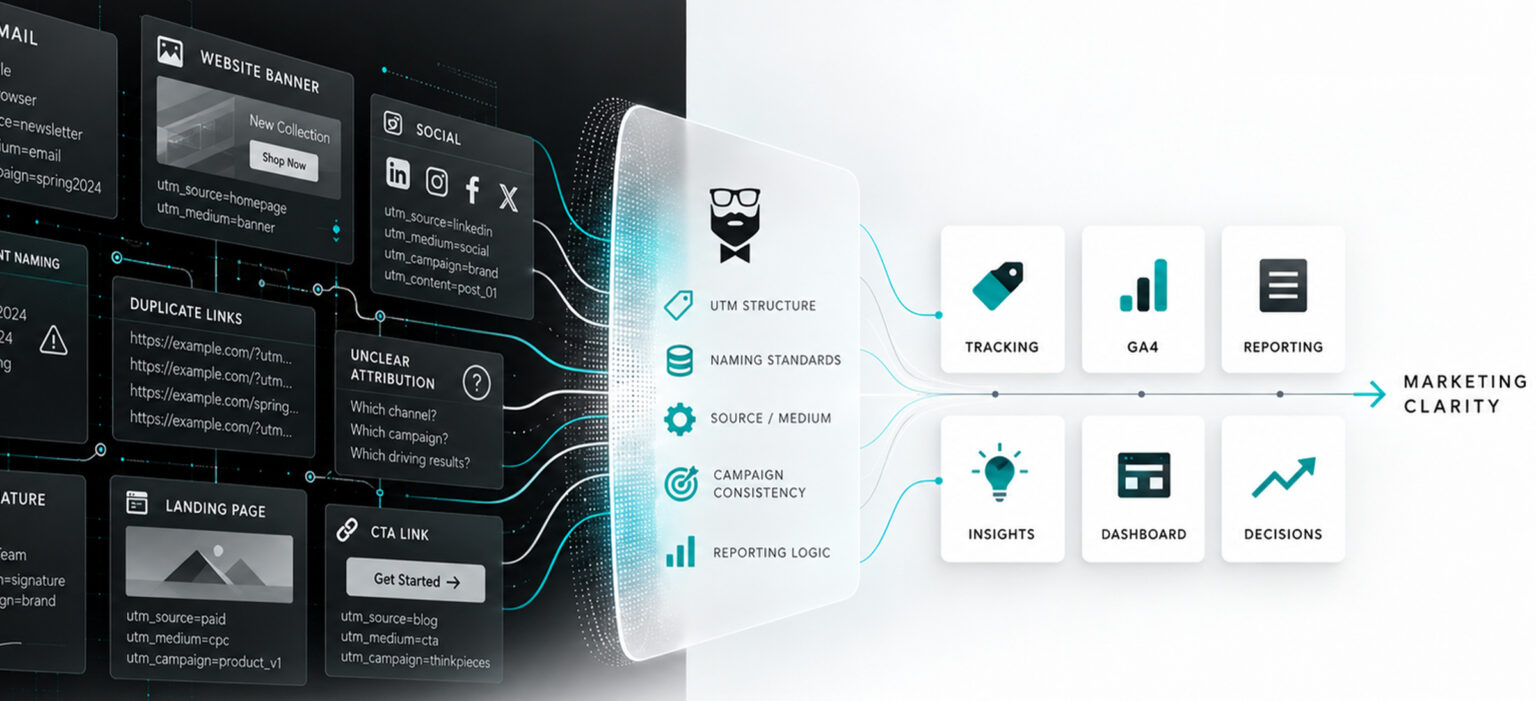
Digital campaigns generate plenty of data, but that data becomes much less useful when every channel, campaign or team uses different naming conventions.
Email campaigns might be tracked correctly while website banners, signatures, external links and other marketing activities are not. Over time, analytics becomes increasingly difficult to interpret because campaign names and sources cannot be compared consistently.
The challenge was therefore not simply to add more tracking. It was to create a structure that marketers could realistically apply across different activities.
The approach
I started by looking at how campaign links were already being used and where inconsistencies appeared. From there, I developed a clearer UTM structure covering source, medium, campaign naming and content identification.
The framework was designed around consistency rather than complexity. A tracking standard only works when the people using it understand the rules and can apply them without needing an analytics specialist every time a link is created.
Documentation and internal adoption were therefore just as important as the technical structure itself.
What I worked on
- UTM naming conventions
- GA4 campaign tracking
- Email campaign tracking
- Website banners and internal campaign links
- Campaign source and medium standards
- Documentation and internal guidelines
- Repeatable marketing workflows
- Cross-channel attribution structure
The outcome
The framework created a clearer foundation for campaign measurement and made it easier to apply consistent tracking across marketing activities.
Instead of treating UTM parameters as something added only to email links, campaign tracking became part of a broader marketing process. This creates better conditions for comparing channels, analysing campaign performance and building more reliable reporting over time.
What this project shows
Marketing analytics only becomes useful when the underlying data is consistent. Better reporting often starts long before the dashboard, with better processes and clearer standards.
Related services
Marketing Operations & AI
Tracking structures, marketing workflows, analytics and smarter ways of working.